Follow us on:


Published on: March 17, 2026
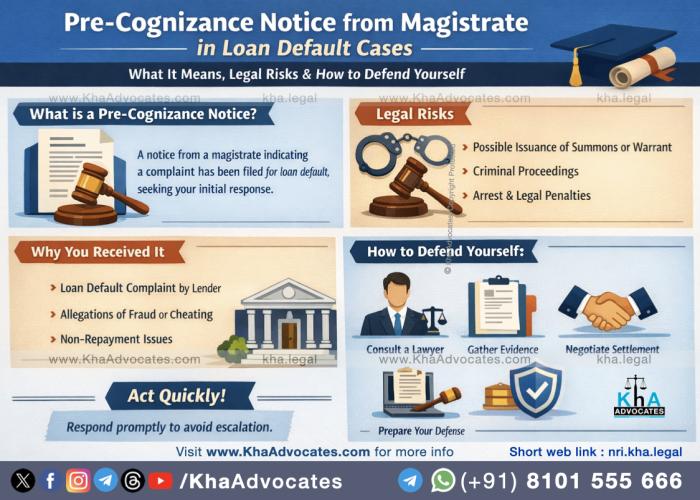
Receiving a pre-cognizance notice from a Magistrate Court can be one of the most alarming experiences for any borrower. Many people initially assume it is merely another recovery notice from a bank or financial institution. In reality, such a notice indicates that a criminal complaint has already reached the court and the matter is now under judicial scrutiny.
Under the modern criminal law framework of India, proceedings before Magistrate Courts are governed by the Bharatiya Nagarik Suraksha Sanhita, while offences such as cheating, fraud, and criminal breach of trust are governed by the Bharatiya Nyaya Sanhita.
If you have received a pre-cognizance notice, ignoring it can lead to serious legal consequences, including summons, warrants, attachment of property, or criminal trial.
This article explains:
• What a pre-cognizance notice means
• Why banks and lenders use criminal proceedings
• The legal consequences for borrowers
• Relevant case laws
• Practical defence strategies
• How experienced lawyers can protect you
A pre-cognizance notice is issued by a Magistrate before deciding whether to take formal cognizance of a criminal complaint.
Under the Bharatiya Nagarik Suraksha Sanhita, a Magistrate receiving a complaint may:
This stage is extremely important because the court is determining whether sufficient grounds exist to start criminal proceedings.
Many borrowers wrongly assume:
“Nothing serious will happen because it is only a notice.”
In reality, the Magistrate is already examining whether the complaint discloses criminal offences under the Bharatiya Nyaya Sanhita.
Loan default is generally a civil matter. However, banks and NBFCs often file criminal complaints alleging:
• Cheating
• Fraudulent intention
• Criminal breach of trust
• Dishonest misrepresentation
These allegations can trigger offences under the Bharatiya Nyaya Sanhita.
Financial institutions usually take this step when they believe:
• Borrower deliberately avoided repayment
• False documents were submitted
• Security was disposed of
• Cheques were dishonoured
• Borrower absconded
Once a complaint is filed before a Magistrate, the matter enters the criminal justice system.
The procedure typically unfolds as follows under the Bharatiya Nagarik Suraksha Sanhita:
The lender files a complaint before the Magistrate.
The Magistrate examines the complainant.
The court may issue notice to the accused.
If the court finds prima facie evidence, it takes cognizance.
The accused is directed to appear before the court.
Failure to appear can lead to:
• Bailable warrants
• Non-bailable warrants
• Proclamation proceedings
Many borrowers make the mistake of ignoring such notices, assuming the dispute is purely financial.
This can lead to severe consequences:
The court may issue summons requiring personal appearance.
If the accused fails to appear, warrants may be issued.
The borrower may face trial for offences under the Bharatiya Nyaya Sanhita.
Criminal proceedings can severely damage:
• business reputation
• employment prospects
• financial credibility
The Supreme Court held that civil disputes should not automatically be converted into criminal cases unless criminal intent exists.
This judgment is frequently relied upon by defence lawyers.
The court clarified that cheating requires dishonest intention at the very beginning of the transaction.
Failure to repay a loan alone does not constitute cheating.
The Supreme Court emphasized that criminal proceedings cannot be used as a pressure tactic in commercial disputes.
Consider the following common scenario.
A business owner takes a ₹25 lakh business loan from an NBFC.
Due to financial losses:
• EMIs stop
• lender issues recovery notices
• borrower negotiates but fails
Eventually the lender files a criminal complaint alleging cheating and fraud.
The Magistrate then issues a pre-cognizance notice.
At this stage, many borrowers panic because the matter has moved from bank recovery to criminal court.
However, with proper legal defence, such cases can often be challenged or dismissed.
A skilled lawyer can challenge such proceedings in several ways.
One of the strongest defences is proving that:
• the loan was taken genuinely
• repayment failure was due to financial distress
Courts have repeatedly held that mere breach of contract is not cheating.
If the dispute relates only to repayment, the defence may argue that it should be resolved through:
• civil courts
• arbitration
• recovery proceedings
The complainant must prove:
• false representation
• dishonest intention
• wrongful gain
Without these elements, criminal liability cannot be established.
In appropriate cases, the accused may approach the High Court seeking quashing of the criminal complaint.
Borrowers often worsen their situation by making these mistakes:
Failure to respond can lead to warrants.
Improper statements before the Magistrate can damage the defence.
Some lenders pressure borrowers into unfair settlement terms.
Recovery agents often exaggerate legal consequences to create fear.
Only a qualified advocate can assess the real legal position.
If you receive such notice, you should immediately:
Early legal advice can prevent escalation.
Your lawyer must carefully examine:
• allegations
• documents
• loan agreement
A detailed reply may be submitted before the court.
If the allegations are baseless, legal remedies can be pursued.
In some cases, negotiated settlement may be the best option.
The pre-cognizance stage is often the best opportunity to stop criminal proceedings.
Once the court takes cognizance and issues summons, the process becomes significantly more complex.
Early intervention can:
• prevent criminal trial
• protect reputation
• reduce financial exposure
Borrowers facing criminal complaints require lawyers who understand both banking law and criminal procedure.
At KHA Advocates, our legal team provides:
• strategic defence in Magistrate courts
• legal analysis of loan disputes
• challenge to false criminal allegations
• representation in bail proceedings
• High Court petitions for quashing complaints
With extensive experience in financial dispute litigation, we help clients protect their rights and reputation.
KHA Advocates
New Town, Hatiara Dhankal
Kolkata – 700157
West Bengal, India
📞 Phone: +91-9477758886
📧 Email: contact@khaadvocates.in
🌐 Website: www.khaadvocates.com
✔ Experienced in Criminal & Financial Litigation
✔ Strong Defence in Magistrate Courts
✔ Expertise in Loan Default & Banking Disputes
✔ Strategic Case Handling to Prevent Arrest & Trial
If you have already received a court notice, every day matters. A delayed response can result in:
• Summons
• Warrants
• Criminal Trial
👉 Call now or book a consultation to protect your legal rights immediately.


KhA Advocates is a premier law firm in Kolkata, West Bengal known Internationally, providing expert legal services in property registration, corporate law, matrimonial law, taxation, dispute resolution, and more. We offer tailored legal solutions for NRIs, businesses, and residents, ensuring 100% compliance and protection. With our efficient, transparent, and reliable approach, we safeguard your legal interests.